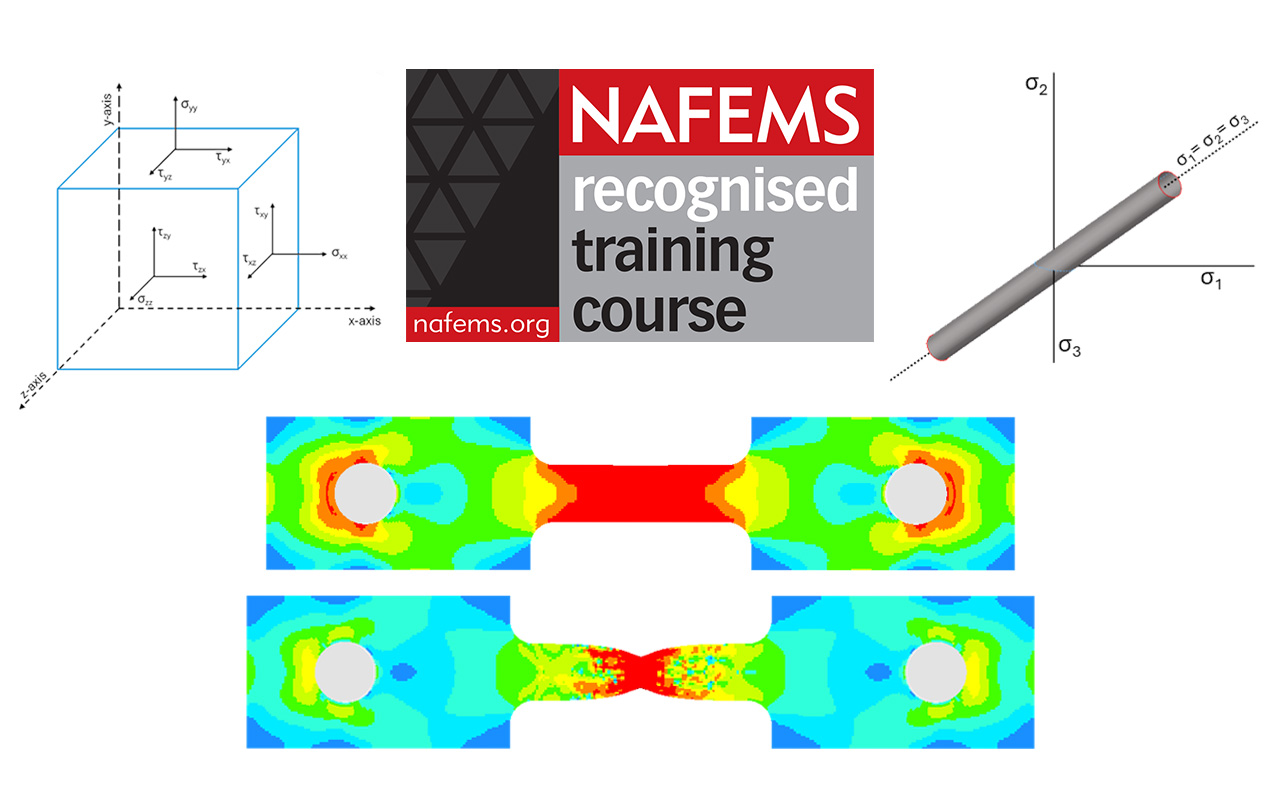
Fundamentals & Application of FEA
NAFEMS-recognised, code-independent training designed to develop a practical understanding of finite element analysis through illustrative examples of linear and non-linear structural response in steel structures.
The course introduces material failure theories, methods for assessing bolted and welded connections, and the significance of resonance when structures are subjected to dynamic loading.
Applying FEA to structural design.
- Linear and non-linear behaviour of steel structures
- Load application, boundary conditions and interpretation of results
- Material failure theories
- Assessment of bolted and welded connections
- Resonance and structural response to dynamic loading
NAFEMS-recognised Fundamentals & Application of FEA.
The course combines code-independent finite element principles with practical structural examples, supporting the assessment and interpretation of simulation results.
Experienced delivery grounded in real engineering work.
“Excellent course, Chris Brooks has a wealth of experience and knowledge which is evident throughout his delivery of the Fundamentals & Application of FEA.”
Richard Clements
Mechanical Engineering Capability Manager · Babcock
Attendee feedback
Average across all five feedback questions
The course content was applicable to my engineering role
I feel more confident about approaching FEA tasks having completed the course
The learning materials provided were of high quality
The instructor communicated clearly in an unambiguous manner
The instructor's knowledge was broad and sufficient to deliver the training
Based on 33 completed questionnaires across three course deliveries, November 2024–February 2026. The overall score is the mean of 165 answers to five questions scored from 1 to 5. One unreturned questionnaire is excluded.
View all response counts
| Question | 1 | 2 | 3 | 4 | 5 |
|---|---|---|---|---|---|
| Q1 | 0 | 1 | 1 | 10 | 21 |
| Q2 | 0 | 1 | 3 | 16 | 13 |
| Q3 | 0 | 0 | 0 | 9 | 24 |
| Q4 | 0 | 0 | 1 | 5 | 27 |
| Q5 | 0 | 0 | 0 | 1 | 32 |
Q1–Q5 correspond to the five statements above, in the same order. These are course feedback scores, not ratings from an independent review platform.
For engineers using, reviewing or commissioning FEA.
The course is relevant to FEA analysts, design engineers, technical reviewers and engineering managers involved in structural simulation.
FEA engineers
Develop modelling practices, verification techniques and results interpretation skills.
Design engineers
Apply simulation insight to structural design assessment and development.
Technical reviewers
Evaluate modelling assumptions, numerical methods and supporting evidence.
Engineering managers
Appreciate the analysis process, resources and verification activities required to deliver credible engineering results.
Explore our wider simulation services.
Practical FEA training for your engineering team.
Contact us to discuss the course content, delivery arrangements and the needs of your delegates.