Go beyond first yield and small-displacement assumptions.
Many engineering questions begin where linear static analysis stops. Stiffness may change as materials yield, geometry may alter the load path, components may come into or out of contact, and damage may localise progressively.
We use non-linear analysis to follow those mechanisms through the load history and identify the response that actually governs the design.
Material non-linearity
Yielding, hardening, damage, cracking and other constitutive behaviour.
Geometric non-linearity
Large displacement, rotation and stiffness changes as geometry evolves.
Contact non-linearity
Opening, closing, sliding and load transfer between interacting parts.
Progressive response
Load–displacement behaviour and failure mechanisms through the complete event.
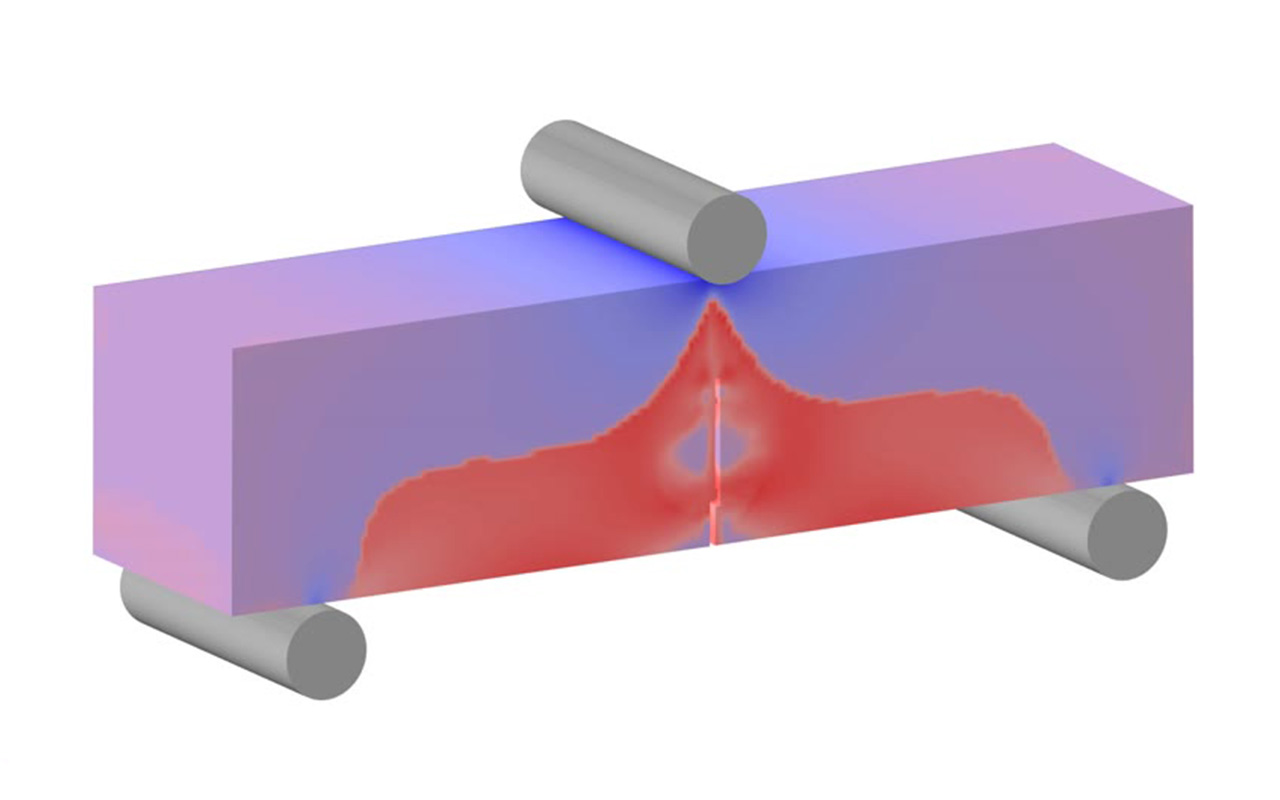
Investigating flexural response and post-cracking load-carrying capacity.
This three-point bending simulation illustrates the non-linear response of concrete under flexural loading. Non-linear FEA can be used to compare the cracking behaviour and load-carrying capacity of plain concrete, conventionally reinforced concrete, fibre-reinforced concrete (FRC) and hybrid rebar–FRC configurations.
Non-linear methods for realistic structural behaviour.
Concrete & civil structures
Cracking, reinforcement, damage and load redistribution in structural products.
Metal structures
Plastic collapse, local yielding, buckling interaction and residual strength.
Joints & interfaces
Fasteners, contact interfaces and load paths that change as the assembly deforms.
Quasi-static loading
Slow structural events where large deformation or material response remains strongly non-linear.
Explore our wider simulation services.
Need to understand behaviour beyond the linear elastic range?
We can help choose an appropriate non-linear modelling strategy and extract the response that matters to the design decision.